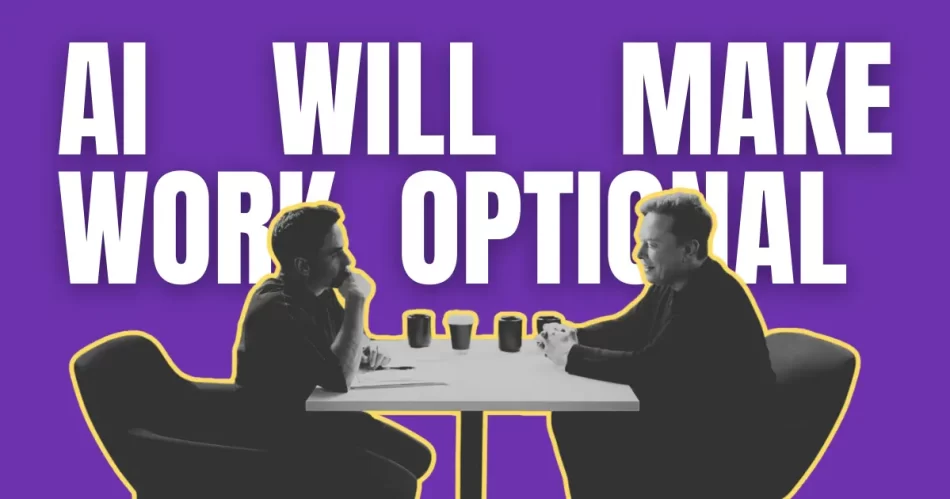
When Elon Musk appeared on Nikhil Kamath’s podcast, one part of the conversation caught the internet instantly. Musk said that in the next ten to twenty years, artificial intelligence will reach a point where work becomes optional. In his words, “My prediction is that, in the future, working will be optional.” It is a headline statement, but the actual conversation goes far deeper than that single idea.
This blog breaks down the most important parts of Elon Musk & Nikhil Kamath’s discussion on podcast around AI, technology, and the future of productivity. Then we share a clear and balanced take on what it truly means for businesses, individuals, and companies like ours that build technology to empower people rather than replace them.
Elon Musk on The Pace of AI Advancement
Musk repeatedly mentioned that artificial intelligence is moving faster than anyone expected. He explained that models are improving at a rate that feels exponential and that the intelligence level of future systems will be far beyond anything we have today. He even said, “In less than 20 years, maybe even 10 or 15 years, advances in AI and robotics will bring us to a point where working is optional.”
He called this a future with abundance. According to him, if machines can deliver products, services, and solutions without limitation, societies will eventually reach a point where basic survival does not depend on human labour. That is how he arrived at the idea that work could become optional.
To explain this shift, he compared it to everyday life choices. Musk said choosing to work in the future might feel like picking vegetables from your own garden instead of buying them from a store — both are available, but one is optional and done for satisfaction rather than necessity.
He also shared a vision of what a highly advanced technological world could look like. He stated, “If you can think of it, you can have it,” suggesting that access to goods and services could become immediate and limitless in an AI powered future. He even extended the idea to economics, saying that if abundance becomes the norm, “money will stop being relevant.”
Taken together, these comments on Nikhil Kamath’s podcast paint a picture of a society transformed by AI and robotics, where human labour is no longer tied to survival, and where technology takes on the bulk of what we today call “work.”
The discussion on human intelligence and machine intelligence
One interesting moment on Nikhil Kamath’s podcast was when Kamath asked Musk if there will be anything humans can do that AI cannot. Musk smiled and said that humans might still do things for emotional or personal satisfaction even if machines can do them better. He compared it to how people choose to play chess even after computers surpassed human champions.
The point he made was not that AI will overpower humanity, but that the relationship between humans and machines will shift. Humans will focus more on purpose, curiosity, and creativity, while machines will handle heavy scale tasks.
Concerns Musk raised about safety and alignment
Along with optimism, Musk also stressed the need for control. He said repeatedly that AI must be aligned with human values and goals. He expressed concerns that without regulation, oversight, and careful engineering, extremely advanced systems may act in ways that do not match human intentions.
This is why he believes responsible development is just as important as rapid advancement.
Did Musk truly mean work will disappear in Nikhil Kamath’s Pocast?
A closer look at the conversation shows that Musk did not claim work as a concept will vanish. His view is that people will still work but out of choice, curiosity, and passion. He imagines a world where survival is no longer tied to labour.
However, even while Musk predicts this future, the conversation pointed to a very real pattern we are already seeing. AI has not removed jobs. Instead, it has shifted them. When tools like ChatGPT emerged, entirely new roles appeared such as
- Prompt Engineer
- AI Workflow Designer
- AI Trainer / Annotator
- AI Product Strategist
- Data Quality Specialist
- LLM Safety Reviewer
- AI Content Curator
- GenAI UX Designer
- Automation Architect
- AI Governance & Ethics Specialist
This clearly shows that new possibilities have opened up instead of shutting existing paths.
Our view as a tech company
AI is becoming incredibly powerful and it will definitely make work easier, faster, and more efficient. We see this every day while building our own AI systems. But saying that work will be optional is a direction, not a destination that arrives suddenly.
Work may evolve, but the need for people to solve problems, innovate, build relationships, design experiences, and guide technology will always exist. Every major technological shift in history has created more opportunities than it removed. Artificial intelligence is following the same pattern.
At our company, we build AI to support people, not replace them. We design tools that reduce boring and repetitive tasks so teams can focus on the meaningful parts of their work. The future is not a world without work. It is a world where human effort is spent on creativity, strategy, decision making, and innovation rather than mechanical tasks.
So yes, we support the vision Musk is pointing toward. But we also believe that people will always remain at the center of progress. AI will not remove the need for human contribution. It will amplify what humans are capable of achieving.